
Costa Rica from Europe means a nonstop flight of 10 to 11.5 hours into San José, no visa for EU and UK passports for up to 180 days, a 6 to 8 hour time difference, American plugs, and dollars that work everywhere. Here is what surprises European guests, and which of our homes fit a first trip.
Which airlines fly nonstop from Europe, and into which airport?
Six European airlines fly nonstop to San José (SJO) as of September 2026. Iberia is the only European carrier with a daily flight all year, per Wikipedia’s airport page, and Iberojet also flies direct from Madrid. FlightConnections lists Air France from Paris in 10 h 30 min, KLM from Amsterdam in 10 h 35 min, Lufthansa from Frankfurt in 11 h 20 min and Edelweiss from Zurich in 10 h 55 min. British Airways is a winter route: its press release of 16 March 2026 says San José goes up to five flights a week and moves from Gatwick to Heathrow, with the first Heathrow flight on 25 October 2026 per the airport page. Fly into SJO for all of our homes; Liberia (LIR) serves the northwest beaches, and only Edelweiss lands there from Europe, seasonally.
Do you need a visa, and what does immigration check?
No visa, for EU and UK passports, for stays of up to 180 days. The British, French, Dutch and Spanish foreign ministries all state that limit (France Diplomatie updated its page on 15 September 2026), and the officer on arrival sets the exact period. Your passport needs to be valid at least one day after the day you leave. You will be asked for a return or onward ticket, and the Costa Rican Tourism Board (ICT) lists proof of means at $100 per month of stay. No vaccine is required when you fly from Europe; the yellow fever certificate applies only if you arrive from a listed risk country. The $29 departure tax normally sits inside your airline ticket, per Spain’s foreign ministry, and cash of $10,000 or more must be declared.
What time is it there, and when does it get dark?
Costa Rica runs on UTC-6 all year with no daylight saving time. That puts it 7 hours behind Spain, France, Germany, the Netherlands and Switzerland in the European winter and 8 hours in summer, and 6 or 7 hours behind the UK, Ireland and Portugal. Flying west, jet lag is the mild kind; the evening is the bigger adjustment. It gets dark at about 18:00 all year, per Two Weeks in Costa Rica, which tells first-timers not to drive long distances after dark because road lines are faded, lighting is scarce and people walk the shoulders without reflectors. Plan every drive to end by 17:30; if you land late, sleep in Escazú and start in the morning.
Will your chargers and hair dryer work?
Bring a plug adapter; the voltage is the smaller problem. Costa Rica uses the flat two-pin type A and grounded type B sockets on 120 V at 60 Hz, per Wikipedia’s mains electricity table (the tourism board rounds it to 110 V). Europe runs 230 V at 50 Hz, so chargers marked 100 to 240 V work with a simple adapter. A hair dryer, straightener or travel kettle rated for 230 V only will run weakly or not at all, so check the label before you pack it.
Should you bring euros, dollars or colones?
Dollars in small notes, plus a card. The colón is the currency, and the ICT says US dollars and major credit cards are widely accepted; euros are not a payment currency here, so change them at home or withdraw colones from a bank ATM on arrival. On 16 September 2026 the Banco Central’s reference rate was 444.46 colones to buy a dollar and 449.49 to sell one, so a 10,000-colón note is roughly $22. Pay in the currency the price is written in, change money only at banks and approved exchange offices, per the ICT, and keep cash for sodas, park entrances and the fruit stand on the road.
How do you get data on your phone?
Buy a local SIM at the airport or install an eSIM before you fly; your EU roaming allowance ends at Europe’s border. The ICT tips page names the kölbi booth at the airport, kölbi being the national carrier, and kölbi’s own site lists a 24-hour unlimited data pack at 1,500 colones, about $3, with a 3 GB fair-use cap. For an eSIM, Airalo sells a Costa Rica plan on the Liberty network at 32.50 € for seven days of unlimited data as of September 2026. Download offline maps before you leave the airport, and navigate to the pin we send rather than the name of the house.
Can you drive on a European license, and do you need a 4x4?
Yes, your EU or UK license is enough for a holiday, and no 4x4 is needed for the three homes below. Spain’s foreign ministry says a license is valid for tourism for up to 180 days, while the ICT’s FAQ still says three months; The Tico Times reported on 30 August 2026 that a reform to Article 91 of the traffic law lets tourists drive for the stay stamped in the passport, so carry your passport when you drive. The rental counter is where Europeans get caught: third-party liability insurance is required by law, cannot be declined, and costs $15 to $25 a day, per Two Weeks in Costa Rica (February 2025); your credit card’s cover applies to collision damage only, so ask for the total with all mandatory insurance in writing before you book. A 4x4 helps in the rainy season on rough routes, the same guide says, but Route 606 to Monteverde is paved, and our driving guide walks you through it.
When is the dry season, and does the Caribbean follow it?
The Pacific side is dry from December to March, and the Caribbean coast does not follow it. Per the Instituto Meteorológico Nacional, the Pacific is dry from December to March with April as a transition and March the driest and hottest month; rainy from May to October with November as the transition; a lull in July and August (the veranillo); and September and October the wettest months. On the Caribbean side there is no defined dry season, but the coast has two drier windows, February to March and September to October, and its wettest month is December. For a European summer holiday that means July and August at Punta Leona fall in the veranillo, while Cahuita is in its second rainy period. If you can travel in September or October, the Caribbean is at its best while the Pacific is at its wettest.
How do tipping and the 13% plus 10% work?
You do not need to tip in restaurants, because the service charge is already on the bill. In restaurants and hotels the 13% value-added tax and a 10% service charge are included in the final price, per the ICT, so a menu price marked “más impuestos” grows by 23% when the bill comes; look for “impuestos incluidos” before you order. Rounding up for good service is a kindness, not a rule. Guides, drivers and the person who cleans the house are not covered by that 10%, so tip them in cash when they did well.
Can you drink the tap water, and what should you watch for?
Yes, in most of the country. The ICT says tap water is drinkable and recommends bottled water only in a few rural areas, and Spain’s foreign ministry gives the same advice for rural zones. Petty theft is the most common crime against tourists, per Two Weeks in Costa Rica: keep nothing visible in a parked car. The risk Europeans underestimate is the sea: France Diplomatie warns that drownings are frequent because of strong rip currents on many beaches, often unguarded, even in calm water; swim where the locals swim. The emergency number is 911, and it works without a local line.
What feels different from Europe?
Mostly the rhythm of the day: dark at 18:00 means an early dinner and an early night, then up with the light, when the wildlife is out. Distances are short on the map and long on the road: our Monteverde loft is about three hours from SJO, Punta Leona about an hour, 90 minutes with traffic, and Cahuita three and a half to four and a half, none of it highway driving. San José airport sits at 921 m, so Central Valley evenings are cool while the beaches run in the 80s and 90s °F, about 27 to 37 °C, per Two Weeks in Costa Rica. Bring a fleece for Monteverde and leave the coat.
Where to stay
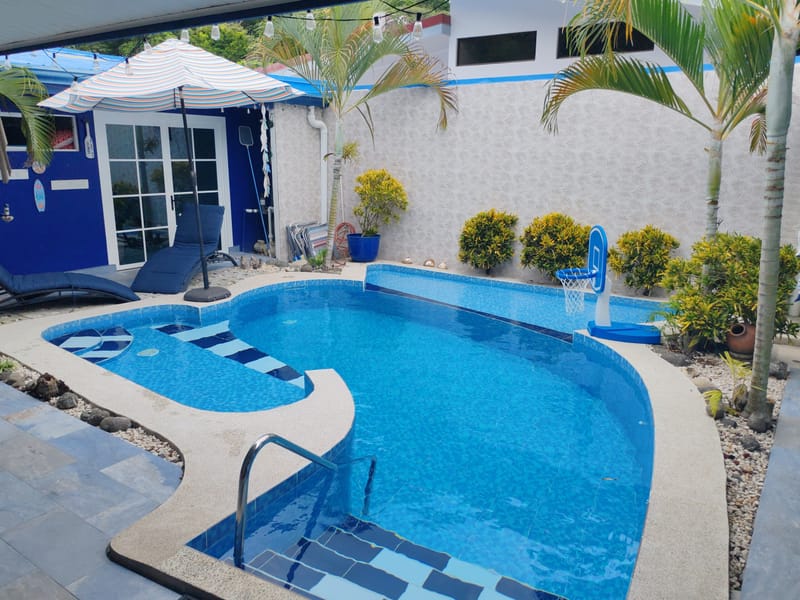
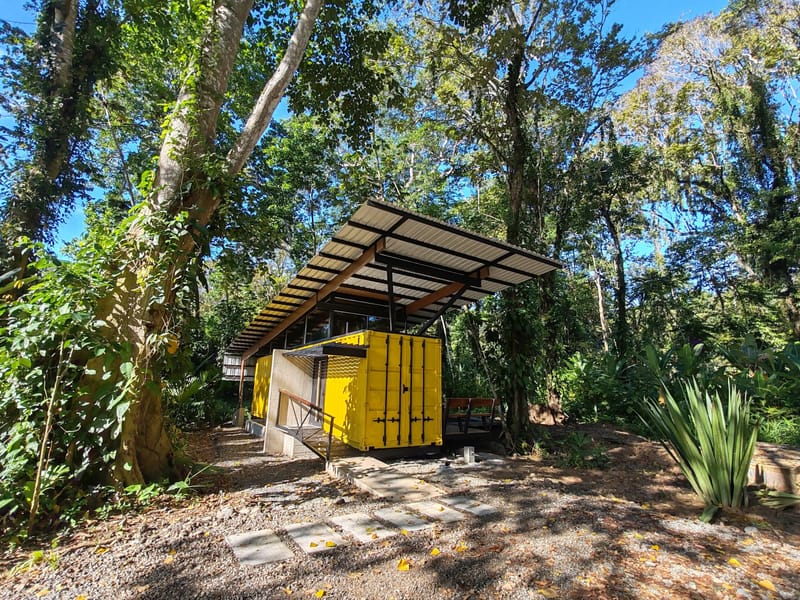
The three homes below are ours, and each fits a first trip from Europe. Kapetsowa Container Loft in Monteverde is a glass-walled container for up to four, a walk from the Cloud Forest Reserve entrance and three hours from SJO on paved road, with early check-in from 11:00 once the clean is done, and bag drop while it finishes. Casa Azul in Punta Leona is a family house for eight with a private pool between the bedrooms, about an hour from the airport, 90 minutes with traffic, an easy first or last night. Ewa Boxes near Cahuita is a pair of yellow container villas with a plunge pool for up to eight and check-in until 02:00, for the Caribbean weeks of September and October. Message us on WhatsApp with your flight number and we will tell you which order to do them in.
Questions this guide answers
Do EU citizens need a visa for Costa Rica?
No. EU and UK passport holders enter without a visa for up to 180 days, per the French, Dutch, Spanish and British foreign ministries as of September 2026, and the exact period is set by the officer at the desk. Your passport must be valid at least one day beyond your departure date, and you need a return or onward ticket. The $29 departure tax is normally already inside your airline ticket.
Which airport should Europeans fly into, San José or Liberia?
San José (SJO) for any of our homes. Every European nonstop lands there: Iberia and Iberojet from Madrid, Air France from Paris, KLM from Amsterdam, Lufthansa from Frankfurt, Edelweiss from Zurich and, from 25 October 2026, British Airways from Heathrow. Liberia (LIR) serves the Guanacaste beaches in the northwest, and the only European carrier that lands there is Edelweiss, on a seasonal flight.
Can you pay in euros in Costa Rica?
Not in practice. The colón is the currency, and US dollars and major cards are widely accepted, per the tourism board, but euros are not used at the till. Bring dollars in small notes or withdraw colones from a bank ATM after you land. On 16 September 2026 the Central Bank's reference rate was about 445 to 450 colones per dollar.
Does a European driving license work in Costa Rica?
Yes, for a holiday. Spain's foreign ministry says a license is valid for tourism for up to 180 days; the tourism board's FAQ says three months; both cover a normal trip. Carry your passport when you drive. Budget $15 to $25 a day for the mandatory liability insurance every rental agency adds, which your credit card does not replace, per Two Weeks in Costa Rica.
Sources
- FlightConnections, nonstop flights to San José (SJO), checked September 2026
- Wikipedia, Juan Santamaría International Airport, airlines and destinations
- Wikipedia, Daniel Oduber Quirós International Airport (Liberia), airlines and destinations
- British Airways media centre, winter 2026 expansion (16 March 2026)
- Iberojet, vuelos a San José de Costa Rica
- Visit Costa Rica (ICT), entry requirements
- Visit Costa Rica (ICT), travel tips (electricity, currency, taxes, SIM, 911)
- Visit Costa Rica (ICT), planning your trip (FAQ on water and driving license)
- GOV.UK, Costa Rica entry requirements
- France Diplomatie, Costa Rica entrée et séjour (updated 15 September 2026)
- France Diplomatie, Costa Rica alerts (rip currents)
- Nederland Wereldwijd, reisadvies Costa Rica
- Ministerio de Asuntos Exteriores de España, recomendaciones de viaje Costa Rica
- Wikipedia, Time in Costa Rica
- Wikipedia, Mains electricity by country
- BCCR reference exchange rate of 16 September 2026, as published by tipodecambio.paginasweb.cr
- kölbi, Internet prepago packages
- Airalo, Costa Rica eSIM (Liberty network)
- The Tico Times, Costa Rica eases driving license rules for tourists (August 2026)
- Two Weeks in Costa Rica, Renting a car in Costa Rica (February 2025)
- Two Weeks in Costa Rica, First-time visit tips (October 2025)
- Instituto Meteorológico Nacional, El clima y las regiones climáticas de Costa Rica (PDF)