February is the middle of the dry season on the Pacific side and in the Central Valley, and the month the Caribbean starts its drier spell. Guanacaste and the central Pacific are hot and close to rainless, San José is mild, Monteverde is cool and breezy, and Cahuita has some of its least rainy weeks. It is still high season, and Costa Rican schools stay on vacation until 1 March 2027, so book early.
What is the weather like in Costa Rica in February?
Dry everywhere we have homes except the Caribbean, which is drier than in January. Patterns come from the Instituto Meteorológico Nacional (IMN) baselines for 1961 to 1990, highs from Costa Rica Vibes (2 November 2026):
Guanacaste and Nicoya (Sámara). The IMN dates the northern Pacific dry season from December to March, when only 4 percent of the year’s rain falls and the northeast trade wind dominates. The Tempisque lowlands, the driest part, collect only 20 to 50 mm in the whole January to March stretch. Costa Rica Vibes gives February highs of 33 to 35 °C.
Central Pacific (Punta Leona). Here the IMN puts the dry period from January to March, again with 4 percent of the yearly rain, after a December that is still a transition. Costa Rica Vibes gives highs of 31 to 33 °C and very little rain.
Central Valley (San José, Escazú). January to March are the dry months, and in the dry season the trade wind blows all day, the IMN says. The wetter eastern side gets more Caribbean rain; Escazú is on the western side. Costa Rica Vibes gives 25 to 27 °C, almost no rain and cool nights.
Monteverde. Costa Rica Vibes’ Monteverde page (updated 27 October 2026) puts February at up to 23 °C by day and around 16 °C in the evening, with about 46 mm of rain, and says it is still windy. Its February guide describes the cloud forest as cool and breezy, with less mist.
Caribbean (Cahuita). The IMN says the Caribbean has no defined dry season, but its rainiest stretch, from November, ends in February, and February to March brings a relative low in rain. The South Caribbean, where Cahuita is, averages 2,500 to 3,000 mm a year. Costa Rica Vibes calls February rain on that coast moderate, with highs of 28 to 30 °C.
As of October 2026, the IMN expected a very strong El Niño through January 2027, weakening after that, with drought persisting on the Pacific and temperatures in 2027 up to 2 °C above normal, per CRHoy (21 October 2026). An earlier IMN projection, reported by El Observador in September, had it lasting until June 2027. Either way, expect a hot, dry February on the Pacific.
For the other months, see Costa Rica weather by month; for the month before, Costa Rica in January.
Why is February the steadiest month of the dry season?
Because every region is past one transition and short of the next. On the Pacific side the IMN treats December as a transition on the central coast and April as the transition back to rain, so February sits in the middle of a dry season that brings 4 percent of the yearly rain.
On the Caribbean, the wettest stretch ends in February. That makes February and March the two months when all five regions on our weather hub are in a dry season or a drier spell at the same time. March is drier and hotter still, but Easter Sunday falls on 28 March 2027 (Costa Rica Vibes), so Holy Week lands at the end of that month.
Guanacaste is usually less windy than in January, per Costa Rica Vibes, which helps snorkeling and boat tours, though wind can still stop zip lines early in the month.
How busy is Costa Rica in February, and when should you book?
Busy, though calmer than the holidays. The tourism board (ICT) counted 308,873 tourists arriving by air in February 2026, 14.06 percent more than in February 2025, per Delfino. Costa Rica Vibes calls February high season, with hotel, tour and rental car prices staying high, and says popular hotels sell out, especially around Valentine’s Day weekend.
It suggests booking flights two to four months ahead, the place to stay as soon as the flights are set, and tours a couple of weeks ahead.
Costa Rican families are on the road too. Under the Ministry of Education (MEP) 2027 calendar, announced on 27 October 2026, teachers return on 8 February and classes start on 1 March 2027, per Delfino. So all of February is still school vacation. Some guides, Costa Rica Vibes among them, say the school year starts in late January; as of November 2026, go by the ministry’s dates.
What events are on in Costa Rica in February 2027?
Few. Costa Rica Vibes notes that February has no national holidays. As of November 2026:
- Ash Wednesday, 10 February 2027. The start of Lent, a working day, per Costa Rica Vibes.
- Día del Amor y la Amistad, Sunday 14 February. Valentine’s Day, and the weekend Costa Rica Vibes says hotels fill first.
- Juego de los Diablitos, Curré. In Curré the Boruca ceremony is held in late January and early February, Thursday to Sunday, per El Observador (January 2026). We found no 2027 date; our holiday festivals guide covers the Boruca edition.
- Envision Festival, Uvita. The 2026 edition ran 23 February to 2 March, per Costa Rica Vibes. As of November 2026, the organizers’ site says they “do not see a path to a 2027 festival” and have no future editions planned, so do not plan a trip around it.
What wildlife can you see in Costa Rica in February?
Whales, turtles and birds. The Marino Ballena National Park leaflet, published on visitcostarica.com, says humpbacks from the north pass through Costa Rican waters between December and April (another panel of the same leaflet says December to March). Costa Rica Vibes names the park, near Uvita, as the most popular place for tours.
The sea turtle infographic on the same site, reviewed by SINAC, puts leatherback nesting on the Pacific from September to March, at beaches including Grande, Ventanas, Langosta and Ostional, and on the Caribbean from February to August, at beaches including Tortuguero, Parismina, Cahuita and Gandoca. Costa Rica Vibes says the Playa Grande season is winding down in February, while olive ridleys nest in smaller numbers all year at Ostional.
For birders, Costa Rica Vibes says February starts prime quetzal season in Monteverde and San Gerardo de Dota, and that in Guanacaste’s dry forest animals gather near rivers and water holes. Our Monteverde Cloud Forest Reserve guide covers the visit.
What should you pack and know for the dry season?
Light clothes, sun protection and one warm layer. Costa Rica Vibes’ February list: light, breathable clothes and a couple of swimsuits, reef-safe sunscreen, a hat and sunglasses, a light jacket or sweater for Monteverde and San José nights, a light rain jacket for the Caribbean, bug spray, sandals plus walking shoes, and a refillable bottle.
The dry season is also fire season. Bomberos counted 209 forest fires from January to late April 2026, a record, with 144 in Guanacaste and more than 28,000 hectares burned, per El Observador (25 April 2026). Bomberos warned that El Niño could make the next dry season more aggressive, and asks everyone to avoid any kind of burning and to report fires on 9-1-1.
The sun sets between about 17:30 and 18:15 all year, Costa Rica Vibes says, so plan to arrive before dark.
Which region fits which February trip?
Choose by what you want from the weather.
- The most sun: Guanacaste and Nicoya. Sámara is about two hours by car from Liberia airport; see the Sámara area guide.
- A beach near San José: the central Pacific. Punta Leona is about 1.5 hours by car from San José airport (SJO) without traffic, and closer to 2 hours with it. See the Punta Leona area guide.
- Cloud forest and quetzals: see the Monteverde area guide.
- Caribbean: February starts its drier spell and its leatherback season. See the Cahuita area guide.
Where to stay in February: our homes
Four of our homes cover the February beaches above.
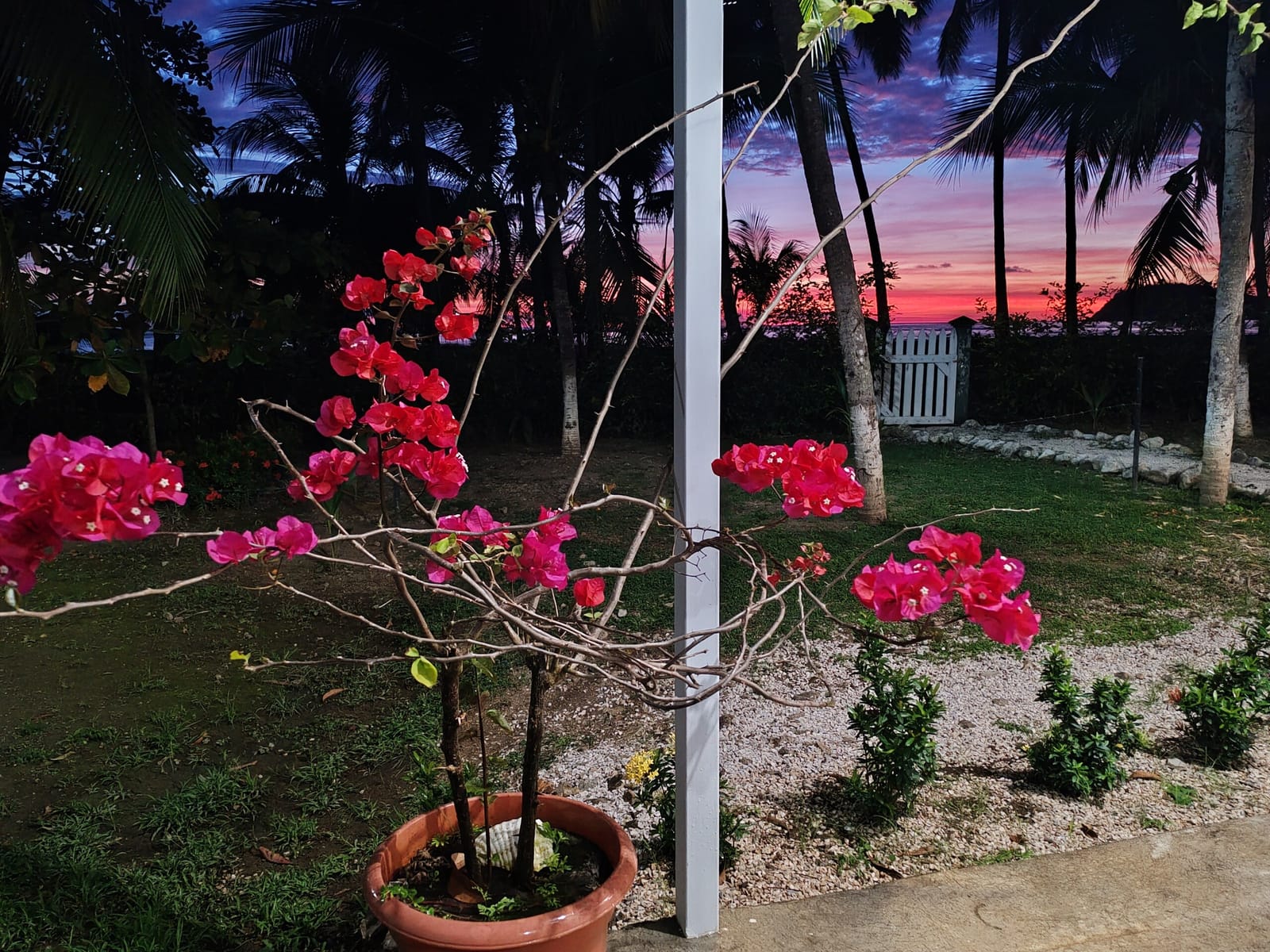
- Casa Almendros, Sámara. Our beachfront house on a quiet stretch of Playa Sámara, with a garden gate to the sand and three bedrooms with air conditioning for up to six. Two-night minimum, from $303 a night.
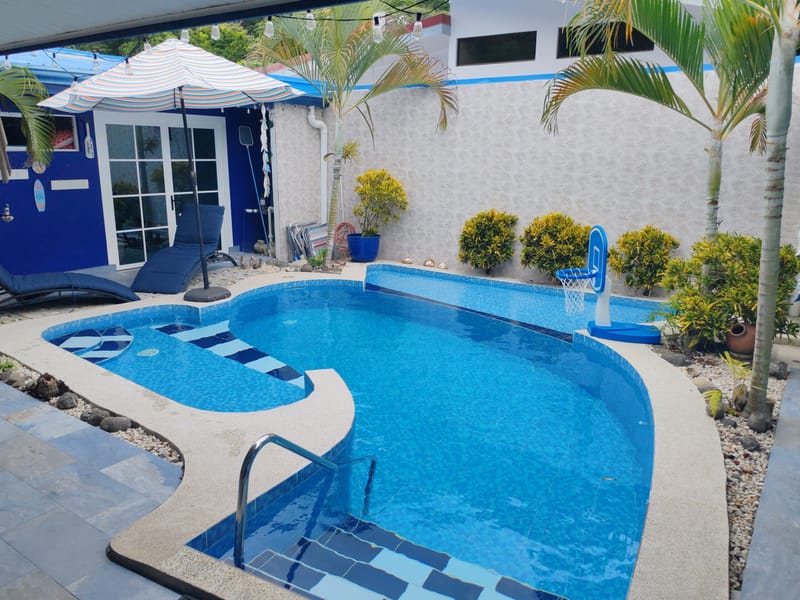
- Casa Azul, Punta Leona. Our single-story family house for up to eight, with a private pool in the middle of the house and the Arenas supermarket 75 meters away. The pool has no gate, so watch small children. From $287 a night.
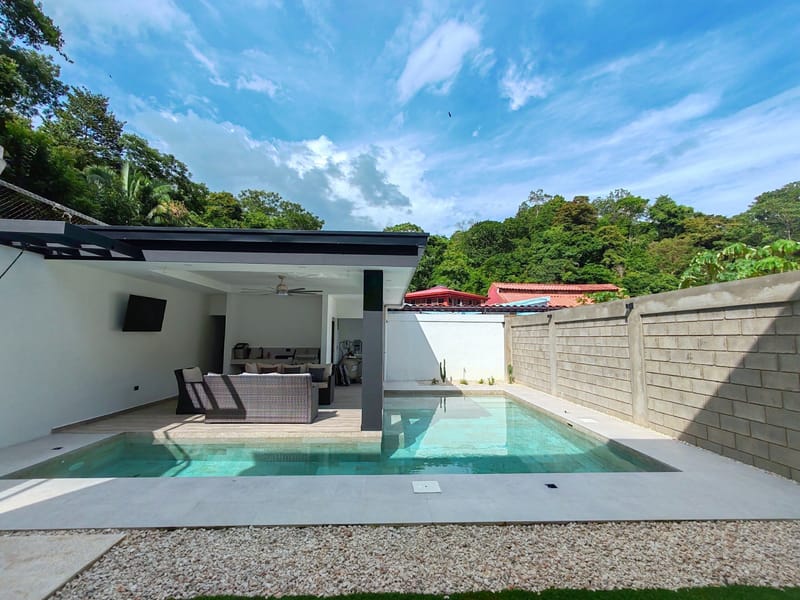
- Lapas Paradise, Punta Leona. Our modern two-story house for up to eight, with air conditioning in almost every room, a ten-minute walk to the beach and a saltwater pool and rancho you may share with Natural Leona next door. Ask us about your dates. From $292 a night.
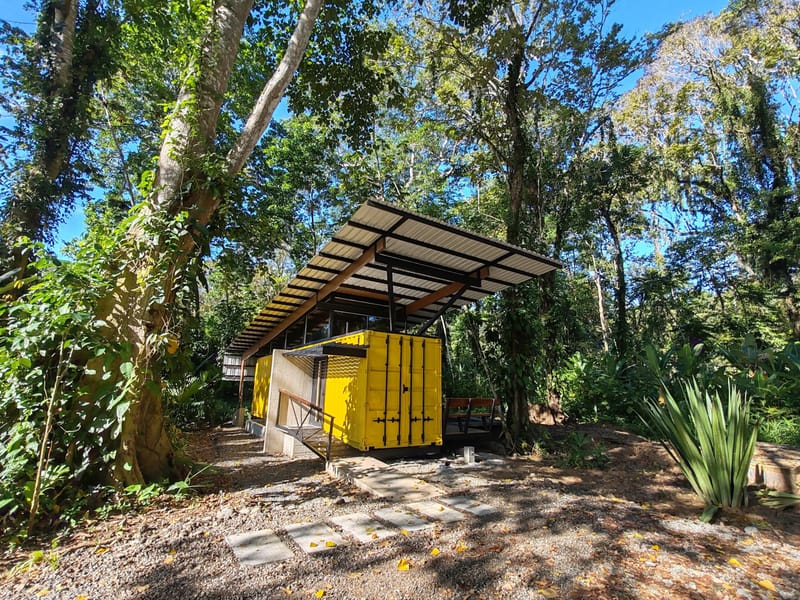
- Ewa Boxes, Cahuita. Our two container villas booked together for up to eight, with air conditioning in each and a plunge pool to yourselves. Keypad check-in runs until 02:00. From $361 a night.
The Airbnb page shows the total for your dates before you confirm. For Valentine’s weekend or the last weekends before classes, message us on WhatsApp with your dates.
Questions this guide answers
What is the weather like in Costa Rica in February?
Dry and hot on the Pacific side, dry and mild in San José, and less rainy than usual on the Caribbean. The IMN puts February inside the Pacific dry season, when about 4 percent of the year's rain falls, and at the start of the Caribbean's drier spell. Costa Rica Vibes gives February highs of 33 to 35 °C in Guanacaste and 21 to 23 °C in Monteverde.
Is Costa Rica crowded in February?
Yes, it is high season, though calmer than December and January. The ICT counted 308,873 tourists arriving by air in February 2026, up 14 percent on 2025, and Costa Rican schools stay on vacation until classes start on 1 March 2027. Book flights two to four months ahead and the house as soon as the flights are set.
Does it rain in Cahuita and the Caribbean in February?
Some, but less than in the months before. The IMN says the Caribbean has no defined dry season, but its wettest stretch ends in February and February to March is a relative low in rain. Costa Rica Vibes calls February rain on the Caribbean moderate, so bring a light rain jacket.
Can you see whales or sea turtles in Costa Rica in February?
Yes. The Marino Ballena National Park leaflet says humpbacks from the north pass through Costa Rican waters between December and April. The SINAC-reviewed turtle infographic puts leatherback nesting on the Pacific from September to March and on the Caribbean from February to August, including Cahuita and Gandoca.
Sources
- IMN, Pacífico Norte climate baseline 1961-1990 (dry season December to March, 4 percent of rain)
- IMN, Pacífico Central climate baseline 1961-1990 (dry period January to March, 4 percent of rain)
- IMN, Región Central climate baseline 1961-1990 (trade wind all day; 20 to 50 mm in the Tempisque, January to March)
- IMN, Vertiente del Caribe climate baseline 1961-1990 (rainy stretch ends in February; Caribe Sur 2,500 to 3,000 mm)
- CRHoy, El Niño mantendrá efectos intensos hasta inicios de 2027 (21 October 2026)
- El Observador, El Niño alcanza intensidad muy fuerte y se extendería hasta junio de 2027 (12 September 2026)
- Costa Rica Vibes, Costa Rica in February (2 November 2026)
- Costa Rica Vibes, Weather in Monteverde by month (updated 27 October 2026)
- Delfino, Ingreso de turistas al país creció 14% en febrero 2026 (16 March 2026)
- Delfino, MEP anuncia el calendario escolar 2027 (27 October 2026)
- El Observador, El juego de los diablitos revive la resistencia indígena (4 January 2026)
- Envision Festival, statement on the festival's future (checked 6 November 2026)
- ICT (visitcostarica.com), Parque Nacional Marino Ballena leaflet (humpback seasons)
- ICT (visitcostarica.com), Infograma de tortugas marinas, reviewed by SINAC (nesting periods)
- El Observador, Récord de 209 incendios forestales en Costa Rica (25 April 2026)