Costa Rica runs on two weather calendars. The Pacific side, Guanacaste and the Central Valley are dry from December to March and wet from May to October, with September and October the rainiest. The South Caribbean flips it: its drier spells are September to October and February to March, and December is its wettest month.
What is the weather like in Costa Rica each month?
It depends on the coast more than the month. The table below covers the five regions where we have homes. The patterns come from the Instituto Meteorológico Nacional (IMN), Costa Rica’s weather service, and its 1961 to 1990 regional climate baselines; Monteverde, which those baselines do not single out, comes from Costa Rica Vibes and the Monteverde reserve.
| Month | Central Valley (Escazú, San José) | Central Pacific (Punta Leona, Jacó) | Guanacaste and Nicoya (Sámara) | Monteverde | South Caribbean (Cahuita) |
|---|---|---|---|---|---|
| January | Dry | Dry | Dry | Dry, windy | Rainy, peak rains |
| February | Dry | Dry | Dry | Dry, windy | Drier spell begins |
| March | Dry, driest month | Dry, driest month | Dry, driest and hottest | Dry, still very windy | Drier spell |
| April | Transition | Transition | Transition | Late dry, first rains | Rainy |
| May | Rainy season starts | Rains start early in the month | Rains set in late in the month | Rainy | Rainy |
| June | Rainy; veranillo de San Juan near the 24th | Rainy | Rainy, first peak; veranillo de San Juan | Rainy | Rainy |
| July | Rainy; canícula from about the 10th | Rainy; little or no veranillo on the coast | Canícula, a drier spell | Rainy, possible short dip | Rainy, second peak |
| August | Canícula to about the 15th, then rain | Rainy | Canícula to about the 15th, then rain | Rainy, heavier | Rainy |
| September | Rainiest | Rainiest | Rainiest | Very wet | Drier spell |
| October | Rainiest | Rainiest | Rainiest | Wettest month | Drier spell |
| November | Transition | Rainy | Transition | Rainy, easing late | Rainy, rising |
| December | Dry | Transition | Dry | Transition, windy late in the month | Wettest month |
The IMN’s numbers for each region, from the same baselines:
| Region and IMN baseline | Average yearly rain | Rain in the dry months | Days with rain a year |
|---|---|---|---|
| Central Valley (Valle Occidental) | 2,300 mm | 4%, December to March | 148 |
| Central Pacific (Jacó station) | 2,700 mm | 4%, January to March | 166 (regional average) |
| Guanacaste and Nicoya (peninsula) | about 1,900 mm | 4%, December to March | 136 (regional average) |
| Monteverde | Not in the IMN baselines | Not in the IMN baselines | Not in the IMN baselines |
| South Caribbean (Caribe Sur) | 2,500 to 3,000 mm | No dry season; 40% falls November to February | 184 |
These are 30-year averages. A single year can run well wetter or drier, and 2026 is one of those years (see the outlook below).
When is the dry season, and when is the green season?
On the Pacific side and in the Central Valley, the dry season runs from December to March, the IMN says, with April as the transition and March the driest and warmest month. The rains run from May to October, with November as the transition back. On the northern Pacific, which covers Guanacaste and the Nicoya Peninsula, only 4% of the year’s rain falls from December to March. The central Pacific lags a month: there the dry core is January to March and December is still a transition.
Costa Ricans call the dry season verano (summer) and the rainy season invierno (winter), by rain rather than temperature, per The Tico Times, which also gives invierno its travel name, the green season. That is why a local will tell you summer starts in December.
The rainy season has two breaks. The veranillo de San Juan is a short dry spell that the IMN says normally falls in the second-to-last week of June, near the 24th. The canícula, a longer drier stretch, usually runs from 10 July to 15 August, when the trade wind strengthens. Neither is guaranteed: in 2022 the IMN reported that San José had no veranillo de San Juan at all. On the central Pacific coast, the IMN says the mountains block the trade wind and the midyear veranillo fades or disappears in the coastal valleys.
On the Pacific side, rain falls mostly in the afternoon and early evening, per the IMN. Plan beaches and hikes for the morning in the green season.
Why does the Caribbean run on its own calendar?
Because its rain comes from different weather. The IMN says the Caribbean slope has no defined dry season: even its least rainy months get 100 to 200 mm. On the coast it has two relatively dry spells, February to March and September to October. The second one lines up with the Pacific’s rainiest months, which makes Cahuita the place to go when the rest of the country is wet.
The rainiest stretch is November to January, driven by cold fronts from the north, and December is the wettest month. About 40% of the year’s rain falls between November and February, and a second rainy period from April to August peaks in July. The IMN says Caribbean rain falls most often at night and in the morning. Our Cahuita National Park guide covers what that means on the trail.
How does the weather work in Monteverde’s cloud forest?
Cool and changeable all year. The Monteverde reserve sits on the Continental Divide, where, in its words, Caribbean moisture meets Pacific wind, and it gives 14 to 22 °C as the temperature range of the forest’s amphibian habitat. Costa Rica Vibes (updated October 2026) puts the dry season at December to April, windy throughout, picking up from late December, and the rainy season at May to November. It gives March about 38 mm of rain and October about 380 mm, with November and December as transition months.
The dry months are also bird months: the reserve says birds nest and show their brightest plumage from December to April. Our Monteverde Cloud Forest Reserve guide covers tickets and trails.
What is the best time to visit Costa Rica?
It depends on what you want the weather to do.
- Beach sun: February and March on the Pacific side. Guanacaste and Nicoya are dry from December, and the central Pacific from January, per the IMN. See our Sámara and Punta Leona pages, or the beaches near San José.
- Cloud forest: December to April for drier trails and nesting birds, per the reserve; bring a windbreaker. See Monteverde.
- Caribbean: September and October, or February and March. Two Weeks in Costa Rica says Cahuita, Puerto Viejo and Tortuguero are typically dry in September and October. See Cahuita.
- Fewer crowds and lower prices: Two Weeks in Costa Rica recommends late November to mid-December and May to August, when hotels and rental cars cost less. Avoid 20 December to 3 January, which Costa Rica Vibes calls the busiest and most expensive stretch of the year, and Semana Santa. Costa Ricans travel in the school holidays too: in 2026 the Ministry of Education’s midyear break ran 6 to 17 July.
- Whales: humpbacks from the Northern Hemisphere arrive between December and March, and those from the Southern Hemisphere between July and October, per Q Costa Rica (February 2026). The Tico Times (September 2026) says the southern season peaks from August to October at Marino Ballena National Park, near Uvita on the south Pacific.
- Turtles: olive ridleys nest at Ostional in Guanacaste all year, but the Tico Times (June 2026) says the largest arribadas come from July to November, especially September and October, and you must go with an accredited local guide. On the Caribbean, Puerto Viejo Satellite lists leatherbacks from March to July, hawksbills in September and October (Cahuita National Park is a good place to look) and green turtles at Tortuguero from July to October.
What will the 2026 to 2027 season look like?
Drier than usual on the Pacific side, and possibly on the Caribbean too. As of October 2026, the IMN expects El Niño to stay very strong from November 2026 to January 2027 and then weaken, per CRHoy (21 October 2026). Through September, rain was 43% below normal on the northern Pacific, 37% below on the central Pacific and 20% below in the Central Valley, while the Caribbean ran 25 to 39% above normal. The IMN also expects temperatures in 2027 up to 2 °C above normal.
For the dry season, La Nación (20 October 2026) reported the IMN’s start dates: 3 to 15 November on the northern Pacific, 8 to 23 November in the Central Valley and 13 to 30 November on the central Pacific. The IMN expects normal dry-season conditions on the Pacific side and in the Central Valley, and 30% less rain than usual from November to January in the northern zone and the Caribbean.
That last forecast cuts against the long-term pattern. In the IMN’s baseline, 93% of the Caribbean’s extreme wet years coincided with El Niño, while on the northern Pacific 79% of extreme dry years were El Niño years. A forecast is not a promise, so pack a rain shell for the Caribbean either way.
Which month and holiday guides go deeper?
Each one picks up where this page stops:
- Costa Rica in December: weather by region, holidays and the 20 December to 3 January peak.
- Christmas in Costa Rica: tamales, the portal and what is open on 24 and 25 December.
- New Year’s Eve in Costa Rica: where to spend 31 December and the drive back on 1 January.
- Costa Rica in January: the first full month of the dry season.
- Costa Rica in February: the steadiest dry month and the last weeks of the school vacation.
Where to stay in each region: our homes
We have one home in each of the five regions in the table.
- Alta Pietra, Escazú. Our one-bedroom apartment in Bello Horizonte, about 15 minutes from downtown San José, with a king bed, city and mountain views, a shared rooftop pool and a private hot tub. Sleeps two, four with the sofa bed. Two-night minimum, from $150 a night.
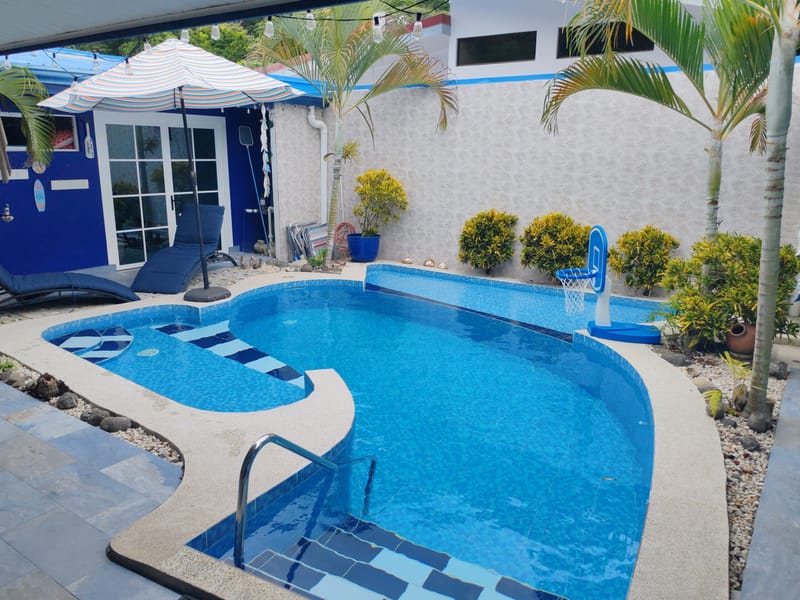
- Casa Azul, Punta Leona. Our single-story family house for up to eight, with a private pool in the middle of the plan and the beach about 15 minutes on foot. About 1.5 hours by car from San José airport (SJO) without traffic, and closer to 2 hours with it. From $287 a night.
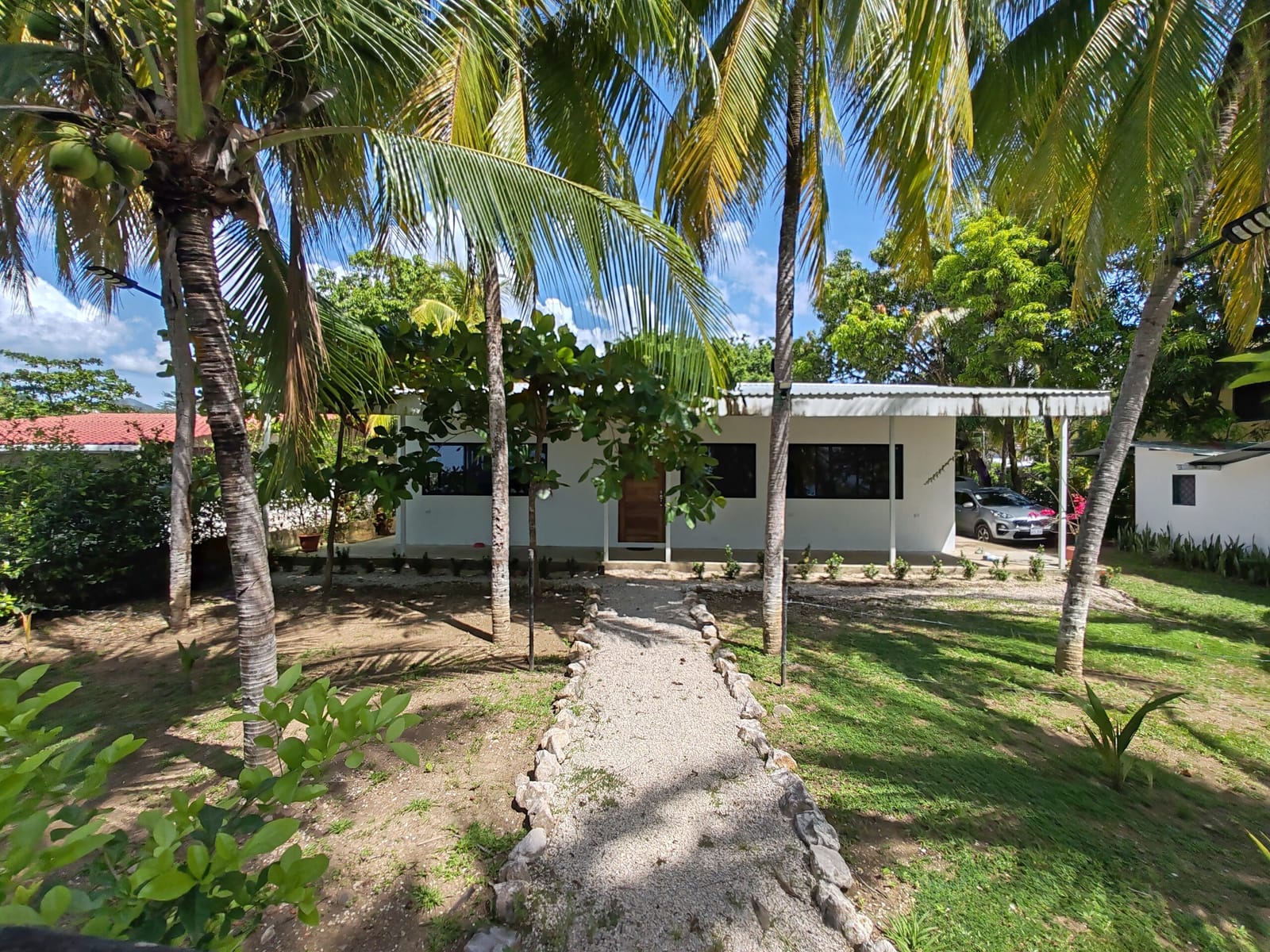
- Casa Almendros, Sámara. Our beachfront house on a quiet stretch of Playa Sámara, three bedrooms with air conditioning for up to six and a garden gate to the sand, about two hours by car from Liberia airport. Two-night minimum, from $303 a night.
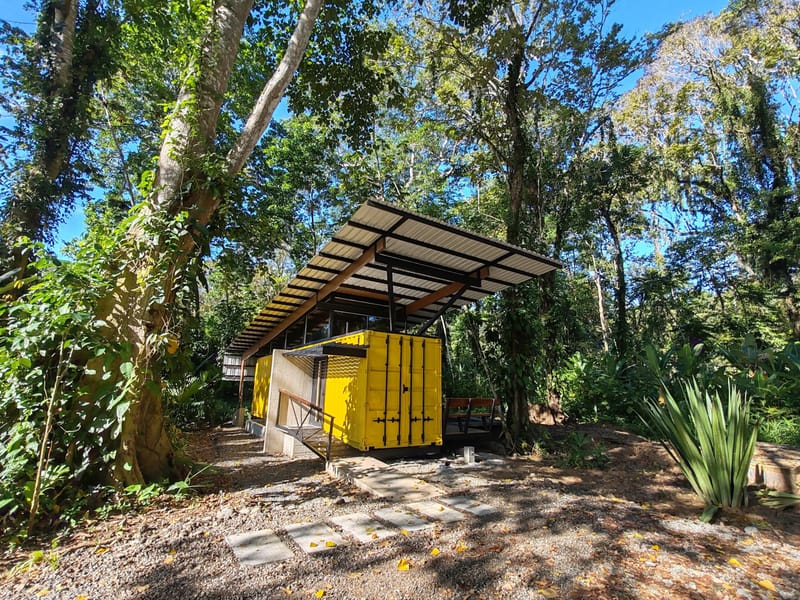
- Calma Loft, Monteverde. Our container loft for two, three with an air mattress, 15 minutes by car from Santa Elena, facing the sunset over the forest, with a fan heater for cold, rainy evenings. The last stretch is short, steep gravel; a 4x4 or SUV is the safer choice in the rainy season. From $103 a night.
- Ewa Boxes, Cahuita. Our two yellow container villas booked together, for up to eight, with air conditioning and a plunge pool to yourselves in the jungle; guests put the beaches about ten minutes away by car. From $361 a night.
Those are the lowest prices we have seen on Airbnb; holiday dates cost more, and the Airbnb page shows the total for your dates before you confirm. Message us on WhatsApp with your dates.
Questions this guide answers
What is the best month to visit Costa Rica?
For beach sun, February or March. The IMN puts the Pacific dry season from December to March and names March the driest and warmest month on that side. For the Caribbean, pick September, October, February or March, its drier spells. To avoid the holiday crowds, skip 20 December to 3 January and Semana Santa.
When is the rainy season in Costa Rica?
On the Pacific side and in the Central Valley, from May to October, with November as a transition month and September and October the rainiest, per the IMN. Costa Ricans call it invierno. The Caribbean has no defined dry season: its rainiest stretch is November to January, with December the wettest month.
What is the weather like in Costa Rica in November?
Mixed. The IMN treats November as the transition into the dry season on the Pacific side. For 2026 it expected the dry season to start between 3 and 15 November on the northern Pacific, 8 and 23 November in the Central Valley, and 13 and 30 November on the central Pacific, per La Nación (20 October 2026).
Is the green season a good time to visit Costa Rica?
Yes, if you plan around the rain. On the Pacific side, the IMN says rain falls mostly in the afternoon and early evening, so mornings are the time for the beach or the forest. Two Weeks in Costa Rica calls late November to mid-December and May to August good months to travel, with cheaper hotels and rental cars.
Sources
- IMN, El clima y las regiones climáticas de Costa Rica (Pacific and Caribbean regimes)
- IMN, Pacífico Norte climate baseline 1961-1990
- IMN, Pacífico Central climate baseline 1961-1990
- IMN, Región Central climate baseline 1961-1990 (Valle Occidental)
- IMN, Vertiente del Caribe climate baseline 1961-1990 (Caribe Sur)
- IMN, Estado de los veranillos del 2022 (13 July 2022; usual dates of the veranillo de San Juan and the canícula)
- La Nación, IMN anuncia cuándo comenzará la época seca (20 October 2026)
- CRHoy, El Niño mantendrá efectos intensos hasta inicios de 2027 (21 October 2026)
- The Tico Times, Costa Rica weather guide (verano and invierno)
- Costa Rica Vibes, Weather in Monteverde by month (updated 27 October 2026)
- Monteverde Cloud Forest Biological Preserve, wildlife of the cloud forest
- Two Weeks in Costa Rica, Best time to visit Costa Rica (updated 22 October 2025)
- Costa Rica Vibes, Costa Rica in December (holiday peak)
- MEP, MEP presenta Calendario Escolar 2026 (19 December 2025)
- The Tico Times, What is an arribada? (29 June 2026)
- Puerto Viejo Satellite, Turtle nesting and hatching on the Caribbean
- The Tico Times, Whale and Dolphin Festival in Uvita (3 September 2026)
- Q Costa Rica, World Whale Day: the best seasons to see them in Costa Rica (16 February 2026)