Cahuita National Park has two entrances: Kelly Creek, next to Cahuita town, where you leave a voluntary cash donation, and Puerto Vargas, about 5 km south, where non-residents pay $5.65. Both open daily from 8:00 to 16:00. An 8.3 km coastal trail joins them, and you can snorkel the reef only with a guide.
How do the two entrances compare?
The hours are the same; the fee and the way you arrive are not. As of October 2026, SINAC, the agency that runs Costa Rica’s national parks, lists both sectors as open every day from 8:00 to 16:00.
- Kelly Creek (Playa Blanca sector). Next to the town of Cahuita, reached on foot over a footbridge across the creek, per Puerto Viejo Satellite, with toilets and showers just past the gate. Entry is a voluntary cash contribution that SINAC says goes back into the park’s community; Puerto Viejo Satellite suggests $5.
- Puerto Vargas. About 5 km south of town, just off the highway, per Two Weeks in Costa Rica. SINAC lists $5.65 for non-resident foreigners, children included, and 1,130 colones for Costa Rican residents (565 for resident children), tax included. SINAC says it accepts credit cards, and the ICT’s park sheet (2023 version) says cards only, no cash, so bring a card. Parking is on this side.
Neither gate needs a booking: the ICT sheet says Puerto Vargas requires no reservation, and Two Weeks in Costa Rica says advance online tickets are not needed. If you drive to Kelly Creek, Costa Rica Vibes (updated October 2026) puts the paid lot in town at about 3,000 colones, while parking at Puerto Vargas is included in the fee.
How long is the coastal trail, and how long does it take?
The trail runs 8.3 km one way between Kelly Creek and Puerto Vargas, per Two Weeks in Costa Rica, and it is mostly flat; the heat, the humidity and the river crossing are what make it work. The ICT describes it in three stretches. The first, about 1,500 m from the Kelly Creek end to the Suárez river, is the busiest and gives you Playa Blanca. The second, 2,334 m from the river to Punta Cahuita, is for watching wildlife, and makes the walk to the point 7.2 km there and back. The last, 2,100 m on toward Puerto Vargas, is the least walked and runs through rainforest.
Most people do not walk the whole thing. Costa Rica Vibes says its writers usually spend 3 to 4 hours and turn back about halfway. If you want the full length, walk it one way and ride back: Puerto Viejo Satellite says the Puerto Vargas station has a bus stop on the main road, and Two Weeks in Costa Rica says buses come about every hour. Or start at Puerto Vargas, walk to Punta Cahuita and turn around.
Can you snorkel the reef on your own?
No. Snorkeling in the park is allowed only with a guide, per Two Weeks in Costa Rica and Costa Rica Vibes, and the ICT’s sheet limits it to designated areas and forbids standing on the coral or pulling yourself along it. The reef is why the park exists. SINAC says Cahuita was made a national monument in 1970 to protect it and a national park in 1978, and that about 600 of its 22,400 marine hectares are coral reef, which it calls the most developed on Costa Rica’s Caribbean coast. Two Weeks in Costa Rica counts about 35 coral species and about 125 fish species.
Tours go out by boat to two sites and usually cost around $60 per person, per Two Weeks in Costa Rica (July 2025), often with time on the trail included. The same guide warns that tours are often canceled for poor visibility, so book one early in your stay and keep a spare day. SINAC asks for biodegradable sunscreen.
What wildlife will you see?
Monkeys and sloths are the usual sightings. Along the coastal trails, SINAC lists howler and white-faced monkeys, sloths, toucans, coatis, trogons, night herons, basilisks and the black hawk, plus the eyelash viper, which it calls the tinsel snake. The ICT’s park sheet adds spider monkeys and both two-toed and three-toed sloths, and its Caribbean guide says raccoons, coatis and agoutis are often seen on the ground.
Most of these animals sit still high in the canopy, which is why SINAC recommends a local guide; the park’s guides are trained by INA, the national training institute, and accredited by the ICT. You find them at the Kelly Creek entrance, and Two Weeks in Costa Rica (July 2025) put half-day guided walks at $40 to $75 per person. A guide also finds the eyelash viper, which the same site describes as bright yellow and not usually aggressive.
What should you know about the river, the sea and what to leave behind?
Plan for three things: the river, the currents and the animals. The Suárez river crosses the trail on the Kelly Creek side. Two Weeks in Costa Rica says it can be swift and knee to waist deep, harder at high tide or after heavy rain and easiest at low tide, though it was dry on their September visit; Costa Rica Vibes has never seen it above the knee. Check a tide chart and carry your phone in a dry bag.
In the sea, SINAC lists community lifeguards and safe bathing areas, and the ICT sheet tells you not to swim where signs mark danger. Puerto Viejo Satellite’s advice for a rip current is to swim parallel to the beach until you are out of it, and to call 911 for any emergency.
Leave pets, alcohol and weapons behind; SINAC does not allow them in. Feeding wild animals is prohibited, and Two Weeks in Costa Rica says monkeys and raccoons that get fed become aggressive. The same guide reports a strict no-plastic policy covering bottles, wrappers and single-use containers, so carry snacks in a sealed reusable bag and water in a refillable bottle. Wear closed shoes rather than flip-flops, stay on the trail and keep your bag with you on the beach.
Is Cahuita National Park good with kids?
Yes, if you keep the walk short. The trail is mostly flat, per Two Weeks in Costa Rica, and the first 1,500 m from Kelly Creek reach Playa Blanca, the stretch the ICT describes for swimming and resting under the beach almond trees. For small children that is a full morning: walk in, swim in the bathing area, walk out. At Puerto Vargas, SINAC charges non-resident children the same $5.65 as adults and resident children 565 colones.
Give them two rules before the gate: nothing for the monkeys or the raccoons, and hands off the plants, since Costa Rica Vibes advises staying on the paths and not touching anything, trees included. The same site suggests arriving at the 8:00 opening to beat the crowds.
When is the weather best?
September and October are usually the driest months on this coast, while the Pacific side is in its rainy season. The IMN, Costa Rica’s weather service, says rain on the Caribbean reaches relative minimums in September to October and again in February to March, with the heaviest rain in December and January and again in July. Two Weeks in Costa Rica also picks September and October for Cahuita, for dry weather and the best chance of calm seas for snorkeling. Costa Rica Vibes leans a month earlier, toward August and September.
Pack a rain shell in any month. The ICT park sheet says the park has no dry months, with an average temperature of 27 °C and humidity around 92%, and Costa Rica Vibes notes it stays warm even when it rains.
Where to stay near Cahuita National Park
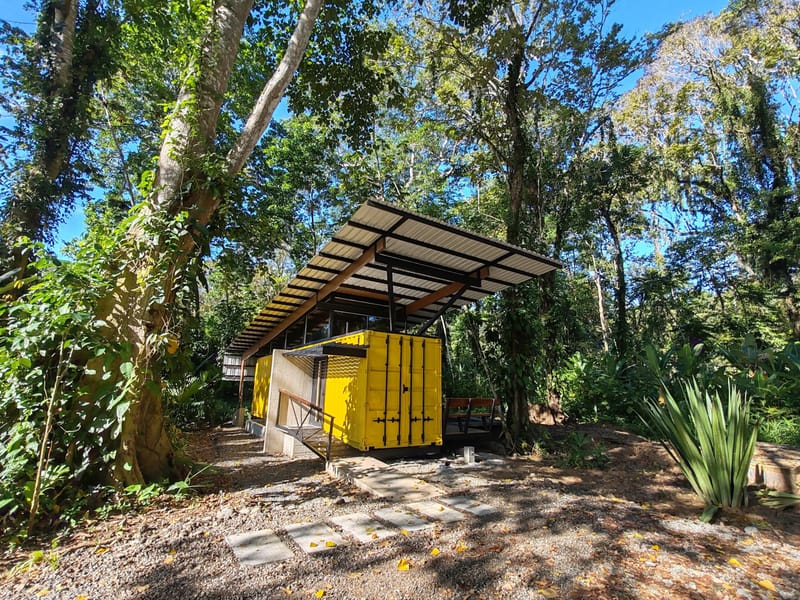
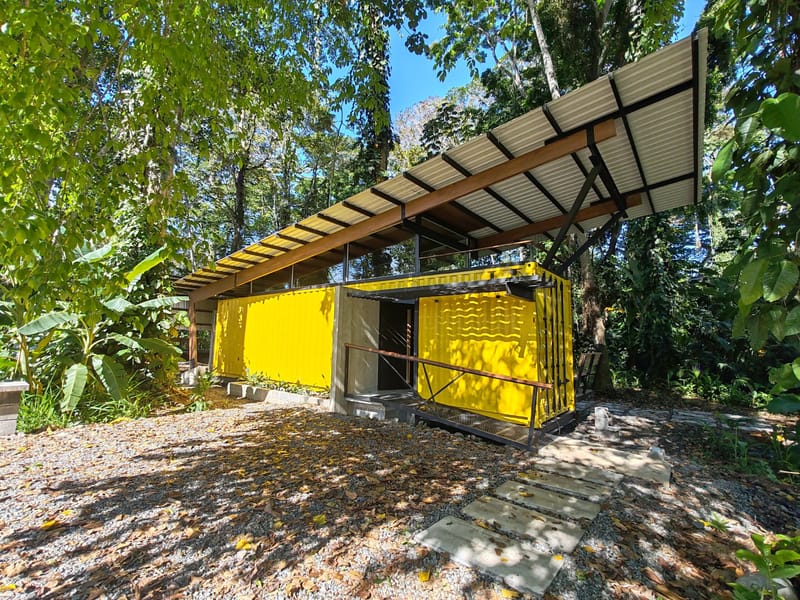
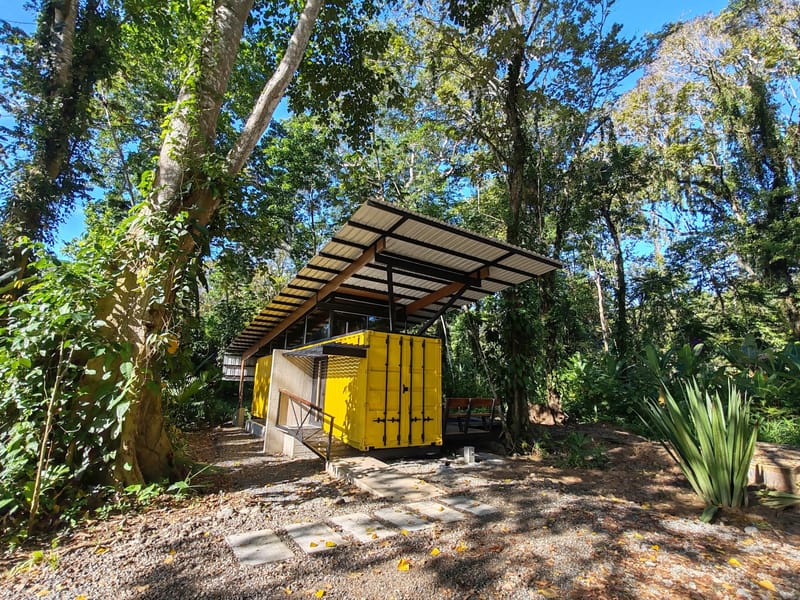
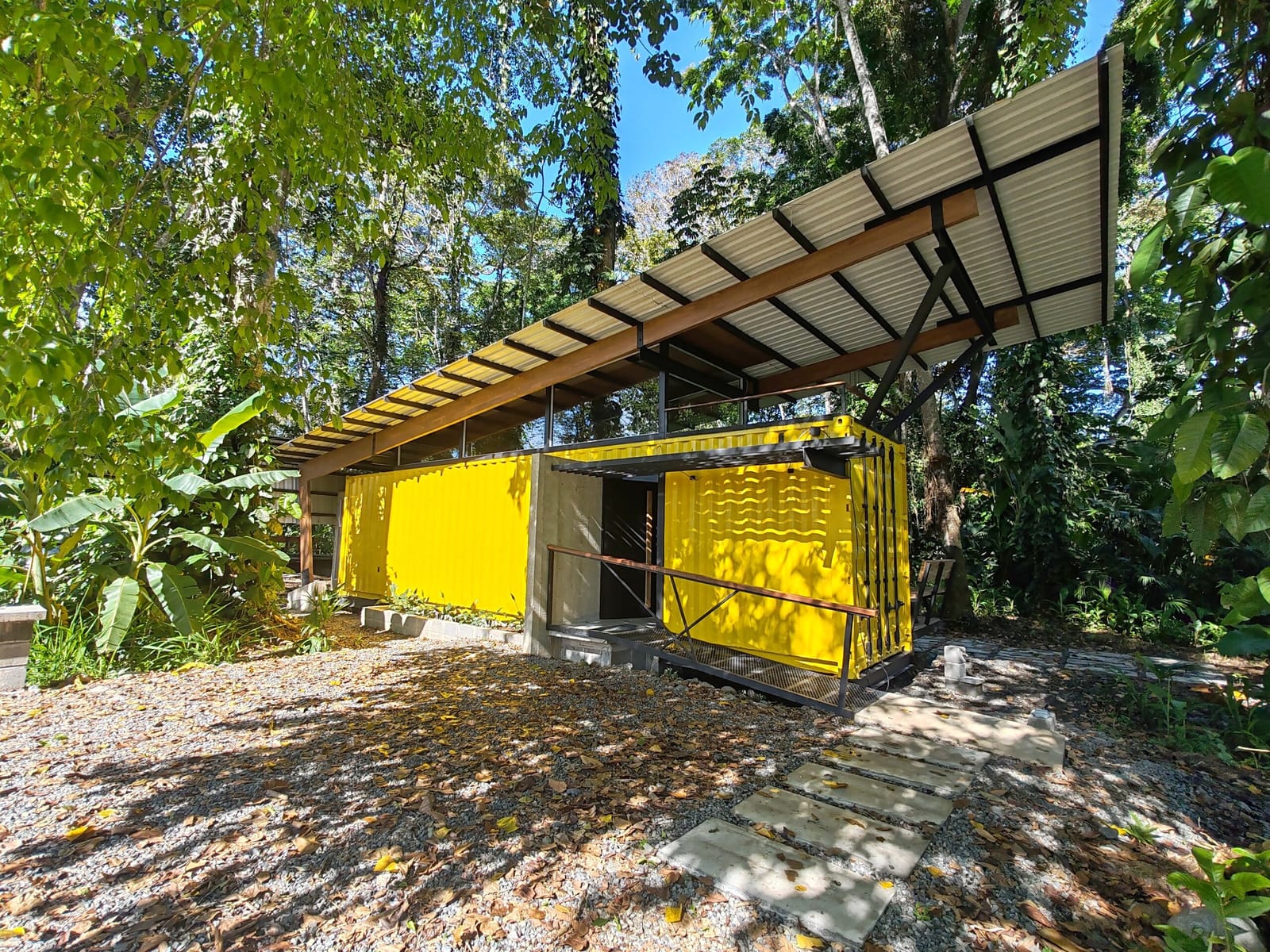
Our three listings are on one jungle plot outside town, close to the main coastal road, and Cahuita National Park is a short drive away. Beaches are about 10 minutes by car. You need a car but not a 4x4; the last three minutes are flat gravel. Check-in runs from 15:00 to 02:00, so a late drive from San José works, and you can drop your bags while the clean is in progress.
- Ewa Boxes books Ewa Box 1 and Ewa Box 2 together, so the plot and the plunge pool are yours alone: up to 8 people in four queen beds, with two bathrooms and two kitchenettes, from $361 a night. It fits two couples, a family or a group of friends.
- Ewa Box 1 is the container without the pool, for up to 4, from $163 a night with a two-night minimum. It suits couples and small families who spend their days on the trail and the beaches.
- Ewa Box 2 is the container with its own plunge pool, for up to 4, from $214 a night with a two-night minimum. It suits couples and small families who want a private pool for less than renting both.
All three have air conditioning, Wi-Fi and a level 2 EV charger. Pets are allowed at the homes but not in the park, so plan the park morning without the dog. If you book one box, another party may be in the other. To compare the town and Playa Negra, read Where to stay in Cahuita; to choose between the two towns, Cahuita vs Puerto Viejo. The full area guide is at Cahuita.
Questions this guide answers
How much does Cahuita National Park cost?
As of October 2026, entry at Kelly Creek, next to Cahuita town, is a voluntary cash donation, and Puerto Viejo Satellite suggests $5. At Puerto Vargas, SINAC lists $5.65 for non-resident adults and children, and 1,130 colones for resident adults and 565 for resident children, tax included. Bring a card for Puerto Vargas.
What are the opening hours of Cahuita National Park?
Both entrances, Kelly Creek (the Playa Blanca sector) and Puerto Vargas, open every day from 8:00 to 16:00, per SINAC as of October 2026. You do not need to book ahead at either gate. Arrive at opening if you want a quieter trail and the whole day for the walk.
Do you need a guide in Cahuita National Park?
Not to walk the trail, but you do to snorkel. Snorkeling over the reef is allowed only with a guide, per Two Weeks in Costa Rica and Costa Rica Vibes, and boat tours run around $60 per person. On the trail, SINAC recommends a local guide to find the sloths and snakes you would otherwise walk past.
How long does it take to hike Cahuita National Park?
The coastal trail runs 8.3 km one way from Kelly Creek to Puerto Vargas, per Two Weeks in Costa Rica, and it is mostly flat. Costa Rica Vibes says its writers usually spend 3 to 4 hours and turn back about halfway. With small children, the 1,500 m walk to Playa Blanca is plenty.
Sources
- SINAC, Cahuita National Park (hours, fees, services, wildlife, rules; checked 27 October 2026)
- SINAC, Parque Nacional Cahuita (fees for non-resident and resident children; checked 27 October 2026)
- ICT, Visit Costa Rica park sheet: Cahuita National Park (version 2023: tickets, rules, trail sections, climate)
- ICT, Caribbean tourist guide, Cahuita National Park (trail sections, ground wildlife)
- IMN, Vertiente Caribe climate chapter (rainy periods and relative minimums)
- Two Weeks in Costa Rica, Cahuita National Park (July 2025)
- Costa Rica Vibes, Cahuita National Park guide (updated October 2026)
- Puerto Viejo Satellite, Cahuita (park stations, suggested donation)
- Puerto Viejo Satellite, safety (currents, lifeguards, 911)